
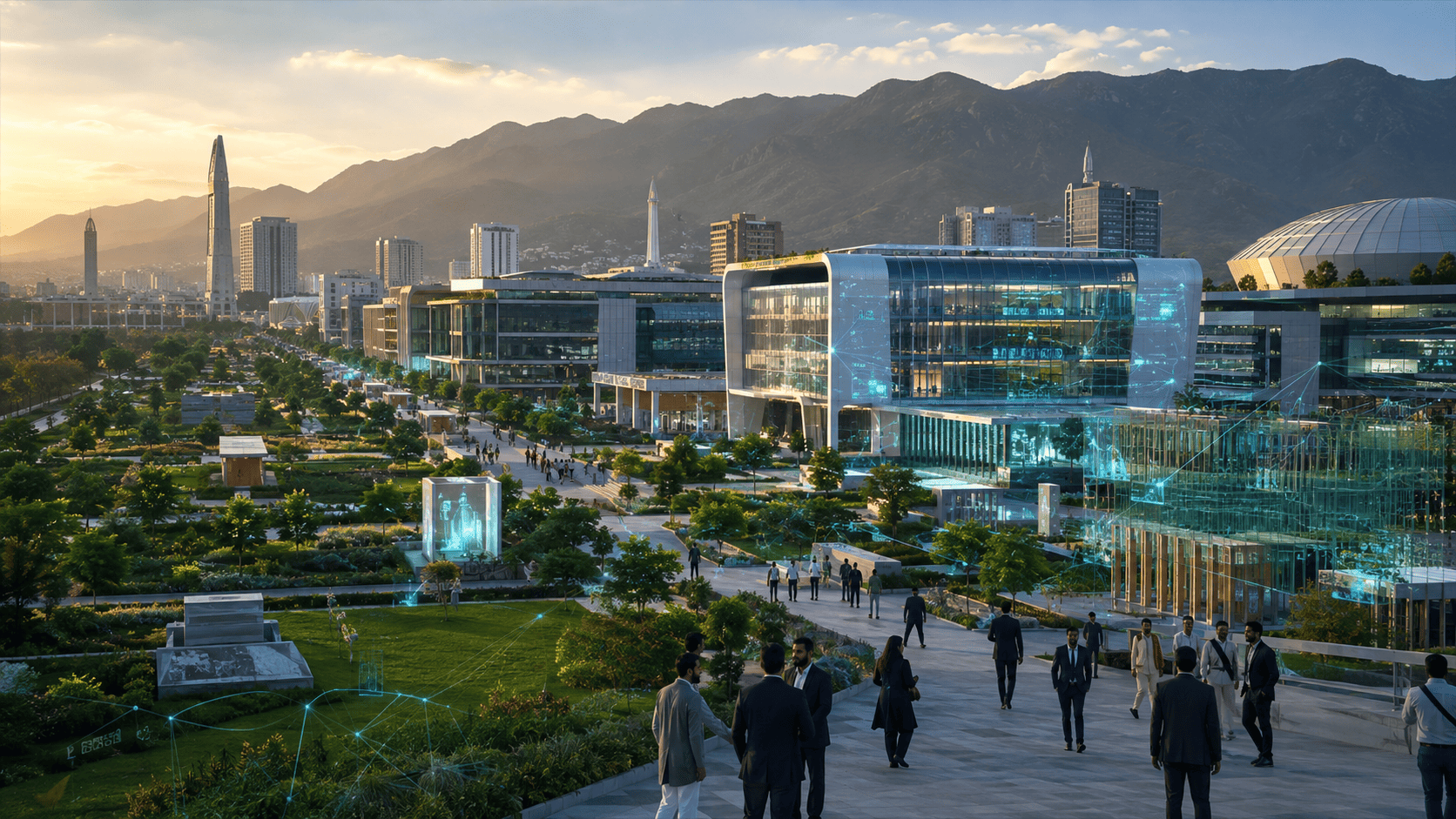
Islamabad Technopolis is moving forward as the government approves funding support to prepare the major technology park for development through a public-private partnership model.
Islamabad is set to get a major new technology hub as the Public Private Partnership Authority (P3A) Board approved funding support for the preparation of Islamabad Technopolis.
The decision was taken during the P3A Board's 44th meeting in Islamabad on Monday, chaired by Prime Minister's Adviser on Privatisation Muhammad Ali.
The funding will be used to prepare the project and hire a transaction adviser who will help develop a viable public-private partnership (PPP) structure for the technology park.
What Is Islamabad Technopolis?
Islamabad Technopolis is a flagship technology-zone project being led by the Special Technology Zones Authority (STZA).
The planned development is designed as an integrated technology ecosystem rather than simply a collection of office buildings.
According to STZA's latest project information, Islamabad Technopolis covers approximately 140 acres and is planned to support areas including ICT, IT-enabled services, high-tech and advanced production, and emerging technologies.
The project is expected to create an environment where technology companies, startups, investors and research-oriented businesses can operate within the same ecosystem.
Why Is the Government Using a PPP Model?
The latest decision is important because the government is looking to bring private-sector investment into the development of the technology hub.
Under the approved approach, project preparation and transaction advisory work will help establish how the public and private sectors can participate in developing the project.
The idea is to use private-sector expertise and capital alongside government support to build and operate the technology ecosystem.
According to ProPakistani, the project will specifically seek private-sector investment as part of the proposed technology hub.
Islamabad Technopolis Could Become a Major Tech Hub
STZA describes Islamabad Technopolis as a project intended to provide infrastructure for technology companies and emerging industries.
Its broader objectives include:
- Increasing technology exports
- Supporting innovation
- Creating skilled employment
- Encouraging technology transfer
- Attracting private investment
- Developing emerging technology businesses
STZA's project material estimates the total investment potential at around $800 million to $1 billion, while the planned site covers 140 acres.
That would make the project considerably larger than a conventional software or office park.
What Technologies Could Be Developed There?
The project is designed to accommodate a wide range of technology-related businesses.
STZA lists areas including:
Information and Communication Technology (ICT)
Software companies, digital services and technology businesses could form a major part of the ecosystem.
IT-Enabled Services
The park could support companies providing global technology and business services.
High-Tech Production
Advanced manufacturing and technology-based production are also included in the project's planned categories.
Emerging Technologies
The project is intended to accommodate newer technology sectors as they develop.
What Could It Mean for Pakistani Startups?
For startups, the biggest potential benefit is access to a concentrated technology ecosystem.
A successful technology park can bring together:
- Startups
- Established IT companies
- Investors
- Research institutions
- Skilled professionals
- Technology service providers
This can make it easier for companies to find talent, partnerships and investment opportunities.
For Pakistan's growing startup and IT sector, having large technology clusters could also help companies compete for international clients.
Potential Boost for IT Exports
Pakistan's technology industry has increasingly become an important source of foreign-exchange earnings.
Projects such as Islamabad Technopolis are intended to strengthen the infrastructure needed for further expansion.
STZA has described the project as a way to accelerate emerging technologies while creating jobs, developing human capital, increasing exports and supporting technology transfer.
If successfully developed, the park could therefore become part of Pakistan's broader strategy to increase technology exports.
The Project Has Already Moved Beyond the Planning Stage
Although the latest announcement focuses on PPP project preparation, Islamabad Technopolis is not a completely new proposal.
STZA has already carried out several development and procurement activities related to the project.
In January 2026, the authority held a pre-bid meeting concerning infrastructure development for Islamabad Technopolis.
STZA's procurement records also list infrastructure-development work for the project.
This means the latest PPP approval represents another step in a longer development process.
Where Will Islamabad Technopolis Be Located?
The planned technology zone is located in Islamabad near NIH Hospital and Park Road, according to STZA.
Project documents identify the site around the area south of Rawal Lake, with access planned through surrounding road infrastructure.
The location gives the project access to Islamabad's existing educational, research and technology ecosystem.
What About Jobs?
One of the major expected benefits is employment.
The project is intended to create opportunities for skilled professionals and support human-capital development.
That could include jobs in software development, artificial intelligence, cybersecurity, cloud computing, fintech, research, engineering and other emerging technology fields.
However, the exact number of jobs that will ultimately be created will depend on the project's final development, companies operating there and the amount of private investment attracted.
Pakistan Is Building More Technology Infrastructure
Islamabad Technopolis is part of a wider push to develop technology infrastructure across Pakistan.
STZA currently lists multiple technology zones across the country, including projects in Islamabad, Punjab and other regions.
The government has also been expanding software technology parks and other digital infrastructure to support IT companies and freelancers.
Pakistan recently inaugurated the Sky47 AI and cloud infrastructure project in Islamabad, highlighting the growing focus on data centres, cloud computing and artificial intelligence infrastructure.
What's Next for Islamabad Technopolis?
The immediate next step is project preparation under the PPP model.
A transaction adviser will help structure the project so that private-sector participation can be attracted.
After that, the development process will depend on the final PPP structure, investment commitments, construction and other required approvals.
STZA currently lists Islamabad Technopolis as under construction/development, while its project presentation indicates that the final completion timeline is still to be determined.
Why This Matters for Pakistan's Tech Industry
Pakistan already has a large pool of software developers, freelancers and IT professionals.
The bigger challenge is building an ecosystem capable of attracting large-scale investment, multinational companies, research activity and advanced technology production.
Islamabad Technopolis is intended to address exactly that gap.
If the project attracts significant private investment and technology companies, it could become one of the country's most important technology clusters.
Bottom Line
Islamabad Technopolis is moving ahead with a new public-private partnership model after the P3A Board approved funding for project preparation and transaction advisory services.
The 140-acre technology park is being developed under STZA and is designed to support ICT, IT-enabled services, high-tech production and emerging technologies.
The project aims to attract private investment, increase technology exports, create skilled jobs and encourage technology transfer.
The bigger question now is how quickly the PPP structure can attract investors and turn Islamabad Technopolis from a planned technology hub into a fully operational ecosystem.
Leave a Comment
Your comment will appear after review.