
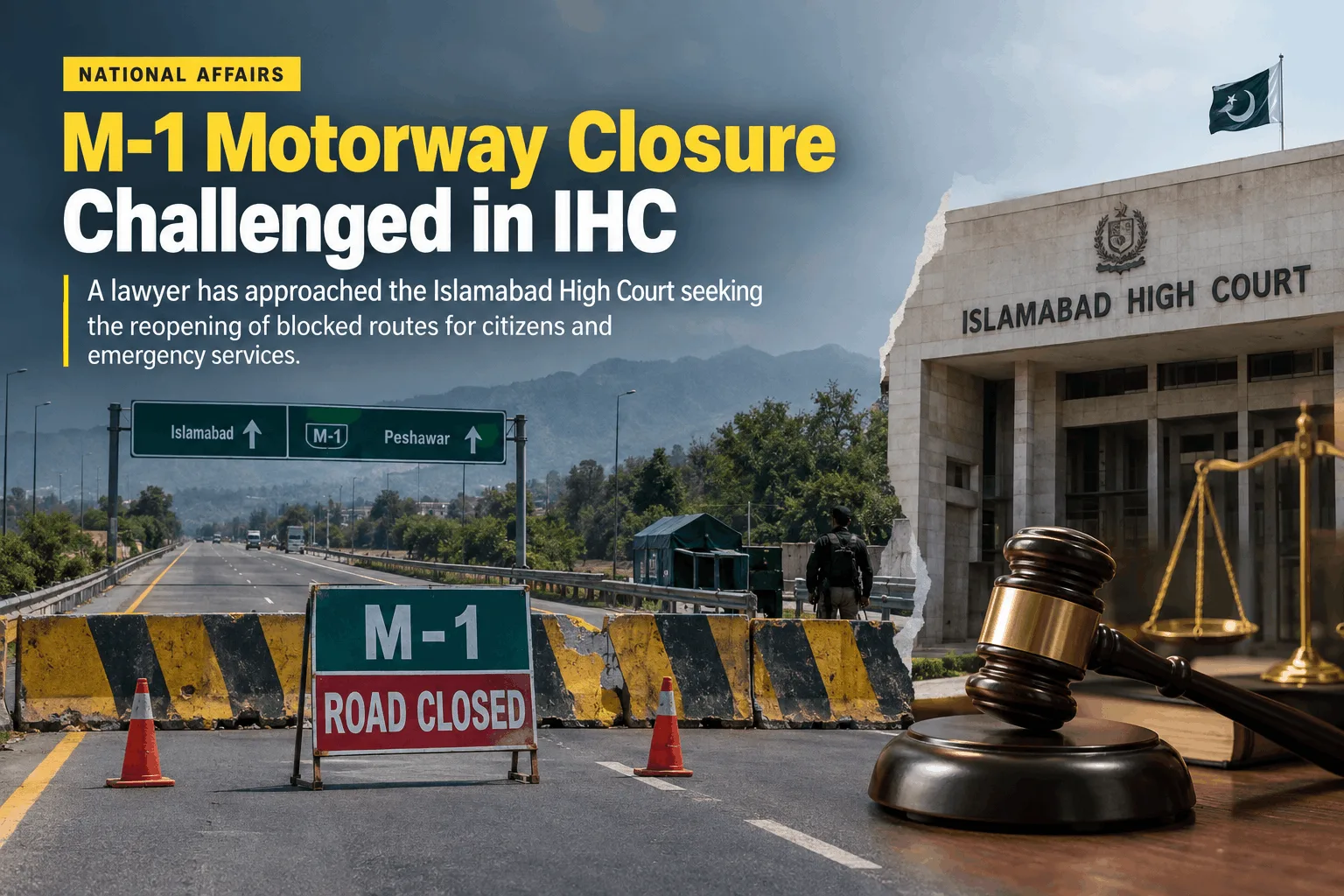
M-1 Motorway Closure Challenged in IHC
A lawyer has approached the Islamabad High Court (IHC) against the closure of the Islamabad-Peshawar Motorway (M-1), seeking the reopening of blocked routes for lawyers, litigants, emergency services and other citizens.
The petition was filed by Supreme Court lawyer Mian Shafqat Jan after he faced difficulties travelling to the Peshawar High Court because of the motorway closure.
According to the petition, the lawyer entered the M-1 from the Islamabad Toll Plaza on September 24 but found the motorway blocked at the M-1 Attock Bridge. He also said he was unable to obtain confirmation about a written order authorising the closure.
Why Was the M-1 Motorway Closed?
The government had announced the closure of the M-1 as security arrangements were intensified ahead of a planned Pakistan Tehreek-e-Insaf (PTI) march towards Islamabad.
The planned protest was linked to demands for the release of PTI founder Imran Khan and calls concerning constitutional supremacy. The party later reportedly deferred the September 27 march.
The National Highways and Motorway Police said the M-1 was closed in both directions between the Islamabad Toll Plaza and Chhachh Interchange. The M-14 was also closed between Hakla and Kundal, while the GT Road was blocked at Attock Khurd.
What Does the Petition Say?
The petitioner argued that closing public roads without a notification, written order or disclosed reasons infringes citizens' fundamental rights.
He has asked the Islamabad High Court to declare such closures illegal and unconstitutional and sought directions for authorities to reopen blocked routes for emergency traffic, lawyers, litigants, witnesses, sick people, funeral processions and other emergency services.
The petition also referred to a recent IHC judgement concerning the planned PTI protest. In that case, the court discussed the constitutional protections available to citizens, including freedom of movement and access to courts.
The court had also directed authorities to ensure that roads, highways, interchanges and toll plazas were not occupied in a way that obstructed public movement or access to medical and educational facilities.
Other Routes Also Affected
The M-1 closure came alongside restrictions on other major routes in the region.
Authorities also closed the Islamabad-Dera Ismail Khan Motorway (M-14), while the GT Road was blocked at Attock Khurd. Security was increased in Attock, with containers and sandbags placed at key bridges and additional security deployed at major entry and exit points.
The federal government also approved the deployment of Rangers in Islamabad and several Punjab districts ahead of the planned PTI march.
Punjab had imposed restrictions on gatherings, while Section 144 was also in force in Islamabad.
Mobile and Internet Restrictions Also Requested
The Punjab government separately requested the federal interior ministry to consider downgrading or jamming mobile and internet services at specific locations in Rawalpindi and Attock on September 27 because of the expected law-and-order situation.
The request was linked to security preparations surrounding the planned protest.
What Happens Next?
The Islamabad High Court will consider the petition and the arguments concerning the legality of the motorway closure.
The case could determine how authorities justify restrictions on major public routes during periods of heightened security and how such measures interact with citizens' access to courts, emergency services and freedom of movement.
Leave a Comment
Your comment will appear after review.