
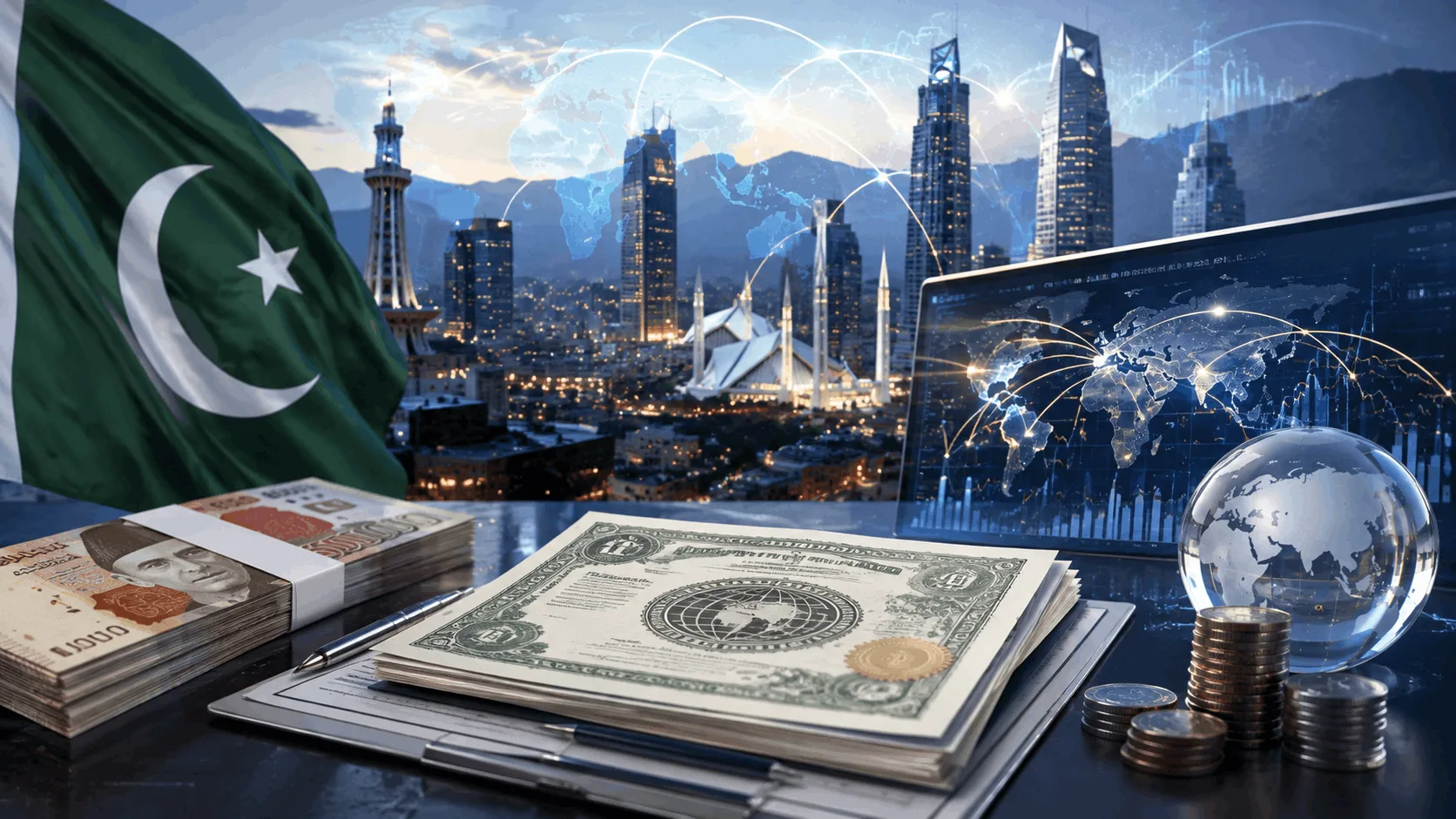
Pakistan Raises $3 Billion Eurobond as It Shifts Away From Bilateral Loans
Pakistan has raised $3 billion from international investors through a record Eurobond transaction, marking a major step in the government's plan to diversify how it finances its external needs.
The move comes as Islamabad seeks to rely less on short-term bilateral financing from friendly countries and increase its access to global capital markets.
The transaction attracted nearly $6 billion in investor orders, almost twice the amount Pakistan ultimately issued. The strong demand came from institutional investors across global markets and was seen by the government as a sign of improving investor confidence.
Pakistan's $3 Billion Eurobond: What Was Issued?
Pakistan raised the money through two dollar-denominated bonds with different maturities.
| Bond | Amount | Maturity | Coupon |
|---|---|---|---|
| First tranche | $1.75 billion | 5.5 years | 7.50% |
| Second tranche | $1.25 billion | 10 years | 7.90% |
| Total | $3 billion | — | — |
The transaction is Pakistan's largest-ever international capital market transaction in a single issuance. It was also the first issuance under the country's renewed Global Medium-Term Note programme.
The strong demand for the 10-year bond is particularly notable because it indicates that investors were willing to lend to Pakistan for a longer period.
Why Is Pakistan Turning to Global Markets?
Pakistan has historically depended heavily on a combination of multilateral institutions, bilateral partners and commercial lenders to meet its external financing requirements.
Bilateral financing can provide important support during periods of financial pressure, but Pakistan also faces repeated refinancing and rollover requirements on some of these loans.
Finance Minister Muhammad Aurangzeb has said the government wants to move toward market-based financing with longer maturities and reduce its reliance on bilateral support.
The objective is not simply to borrow more money. The government says it wants to diversify funding sources, extend debt maturities and reduce the risk of having to repeatedly roll over shorter-term obligations.
What Are Bilateral Loans?
Bilateral loans are loans provided directly by one country to another.
Pakistan has received substantial financial support from countries such as China, Saudi Arabia and the UAE over the years.
These arrangements have helped Pakistan strengthen its foreign-exchange position during periods of financial stress. However, some deposits and loans have relatively short rollover periods, making them an important part of Pakistan's annual external financing strategy.
Finance Minister Aurangzeb previously said Pakistan wanted to replace some of these bilateral obligations with longer-term market borrowing.
Why the $6 Billion Demand Matters
Pakistan ultimately borrowed $3 billion, but investors placed orders worth nearly $6 billion.
That means demand was roughly twice the amount Pakistan issued.
For Pakistan, this is important because access to international bond markets depends heavily on investor willingness to buy the country's debt at acceptable borrowing costs.
The strong order book suggests that international investors are becoming more comfortable with Pakistani sovereign debt following improvements in the country's economic indicators and credit ratings.
However, strong demand should not be confused with cheap financing. Pakistan is still borrowing at relatively high interest rates because its sovereign credit rating remains below investment grade.
Pakistan's Credit Rating Has Improved
Pakistan's return to global debt markets has been supported by recent credit-rating upgrades.
S&P Global raised Pakistan's long-term sovereign rating from B- to B in July 2026, citing improvements in economic reforms, fiscal consolidation and foreign-exchange reserves.
Moody's also upgraded Pakistan's sovereign rating in August, reflecting an improvement in the country's credit profile.
These upgrades matter because a stronger credit rating can improve investor confidence and potentially reduce the cost of future borrowing.
Pakistan Already Returned to International Markets Earlier This Year
The latest $3 billion transaction is not Pakistan's first international bond issuance of 2026.
Pakistan returned to international capital markets in April 2026, after a four-year absence, raising $750 million through a three-year Eurobond.
The country also issued its first Panda Bond in yuan earlier in the year, giving Islamabad another source of international financing.
The latest transaction therefore represents another step in a broader strategy to rebuild Pakistan's presence in international capital markets.
What Does This Mean for Pakistan's Economy?
The impact of the transaction depends on how the borrowed funds are used and how effectively Pakistan manages its overall debt.
The immediate benefit is that Pakistan gains access to $3 billion in foreign currency financing without depending entirely on bilateral lenders.
It also gives the government another financing channel when existing loans mature or need to be refinanced.
The longer-term benefit could be greater flexibility in managing Pakistan's external debt if the country can continue accessing international markets at sustainable rates.
But the bonds are still debt.
Pakistan will eventually have to repay the principal, while also making interest payments according to the terms of the bonds.
Is Pakistan Actually Reducing Its Debt?
Not necessarily.
This distinction is important.
Pakistan raising $3 billion from global investors does not automatically mean that the country's total debt is falling.
Instead, the government's strategy is to change the composition and maturity of its financing.
The government has described its approach as active liability management: diversifying financing sources, extending maturities and reducing refinancing or rollover risks.
In simple terms, Pakistan wants to move from repeatedly asking for short-term rollovers toward having more predictable, longer-term financing.
Why Short-Term Bilateral Financing Can Be a Problem
Pakistan's dependence on bilateral deposits has sometimes created recurring refinancing pressure.
For example, Pakistan has historically relied on deposits and loans from friendly countries to strengthen its foreign-exchange reserves.
When such financing approaches maturity, Islamabad needs to negotiate extensions or repayments.
Finance Minister Aurangzeb has argued that longer-term market borrowing could reduce this repeated rollover pressure.
This does not mean bilateral partners will become irrelevant. Rather, Pakistan is attempting to create a more diversified financing structure.
The Cost of Borrowing Remains High
There is also a major downside.
Pakistan's new bonds carry coupon rates of 7.50% and 7.90%, meaning the country is paying a significant cost to access international capital.
The borrowing cost reflects the risk investors associate with Pakistani sovereign debt.
Pakistan's credit rating has improved, but it remains below investment grade.
Therefore, the long-term success of this strategy will depend partly on whether Pakistan can continue improving its economic fundamentals and credit profile.
If the country's risk premium falls over time, future international borrowing could potentially become cheaper.
What Pakistan Wants to Achieve
The government's broader strategy is increasingly focused on moving from dependence on emergency financing toward more diversified funding.
Finance Minister Muhammad Aurangzeb has previously said Pakistan wants to shift from an economy dependent on aid toward one driven by trade and investment.
That means increasing exports, attracting foreign investment and improving access to international capital markets rather than repeatedly relying on emergency loans.
The government has also been preparing different forms of market financing, including Eurobonds, Sukuk and other international debt instruments.
What Are the Risks?
Pakistan's strategy is not without risks.
The biggest concern is that international borrowing can become expensive if global interest rates rise or investors become more worried about Pakistan's economic position.
Pakistan also needs to generate enough foreign currency through exports, remittances, investment and other sources to service its external debt.
Simply replacing one source of borrowing with another does not solve the underlying balance-of-payments problem.
The more sustainable solution would be to strengthen exports and investment so that Pakistan generates more foreign exchange rather than continuously borrowing it.
What Happens Next?
The $3 billion Eurobond could help Pakistan establish a stronger track record in international markets.
If the country continues implementing economic reforms, improving its credit rating and maintaining stronger foreign-exchange reserves, it could potentially return to international markets more regularly and at lower borrowing costs.
But investors will also be watching Pakistan's fiscal position, current-account balance, inflation, reserves and ability to service external debt.
The success of the strategy will therefore be measured over several years, not simply by the size of one bond sale.
Final Verdict
Pakistan's $3 billion Eurobond sale is an important development, but it should be understood correctly.
The transaction does not mean Pakistan has eliminated its dependence on foreign borrowing. Instead, Islamabad is trying to diversify where it borrows from and extend the maturity of its debt.
The nearly $6 billion order book is a positive sign for Pakistan's access to global capital markets, while the recent credit-rating upgrades have helped create better conditions for international borrowing.
At the same time, borrowing at 7.50% and 7.90% shows that international investors still consider Pakistan a relatively high-risk borrower.
The bigger challenge is therefore ahead: Pakistan needs to use this improved market access alongside stronger exports, investment, fiscal discipline and economic reforms.
If those improvements continue, global capital markets could become a more reliable financing source and reduce the country's repeated dependence on bilateral loan rollovers.
Leave a Comment
Your comment will appear after review.