
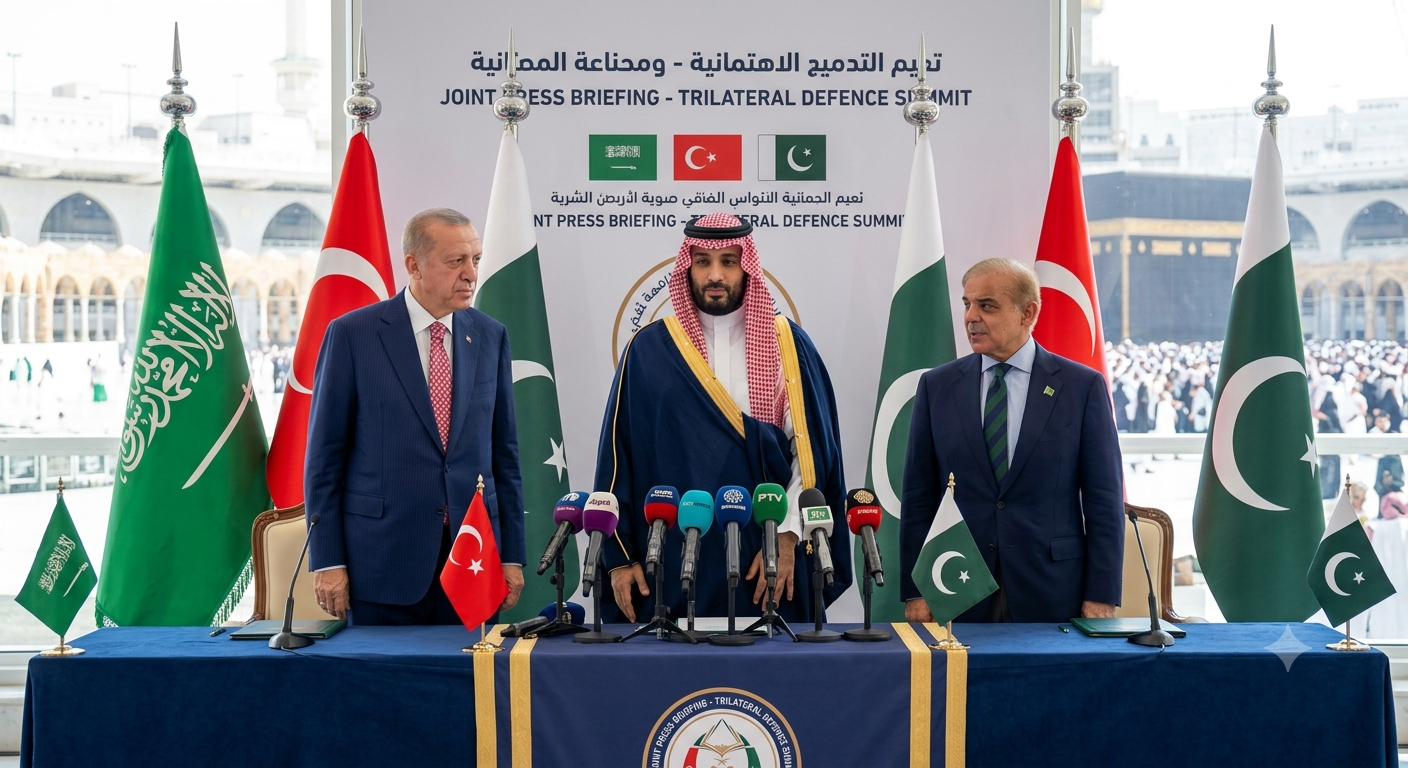
The landmark deal was formally signed at Al-Safa Palace in Makkah by Saudi Crown Prince Mohammed bin Salman, Turkish President Recep Tayyip Erdoğan, and Pakistani Prime Minister Shehbaz Sharif during the Makkah Al-Mukarramah Summit for Joint Defence.
Key Provisions of the Makkah Agreement
The cornerstone of the deal is a mutual collective defense obligation similar to NATO's Article 5 framework:
-
Collective Defense Clause: The treaty explicitly stipulates that an armed attack against any one of the three signatory states will be regarded as an attack against all three.
-
Enhanced Cooperation: Provides a framework for joint military production, defense-industrial footprint expansion, technology partnerships, and greater military interoperability.
-
Strategic Deterrence: Aims to strengthen collective deterrence against external acts of aggression in the region.
Strategic Significance
The alignment brings together three major regional powers—a major Gulf energy superpower (Saudi Arabia), a NATO member with significant military capacity (Turkey), and a nuclear-armed state (Pakistan).
Turkish officials emphasized that the agreement is defensive in nature, open to other regional nations, and meant to complement existing bilateral and multilateral security arrangements. The deal builds upon previous security cooperation, including the bilateral strategic mutual defense pact signed between Saudi Arabia and Pakistan in September 2025.