

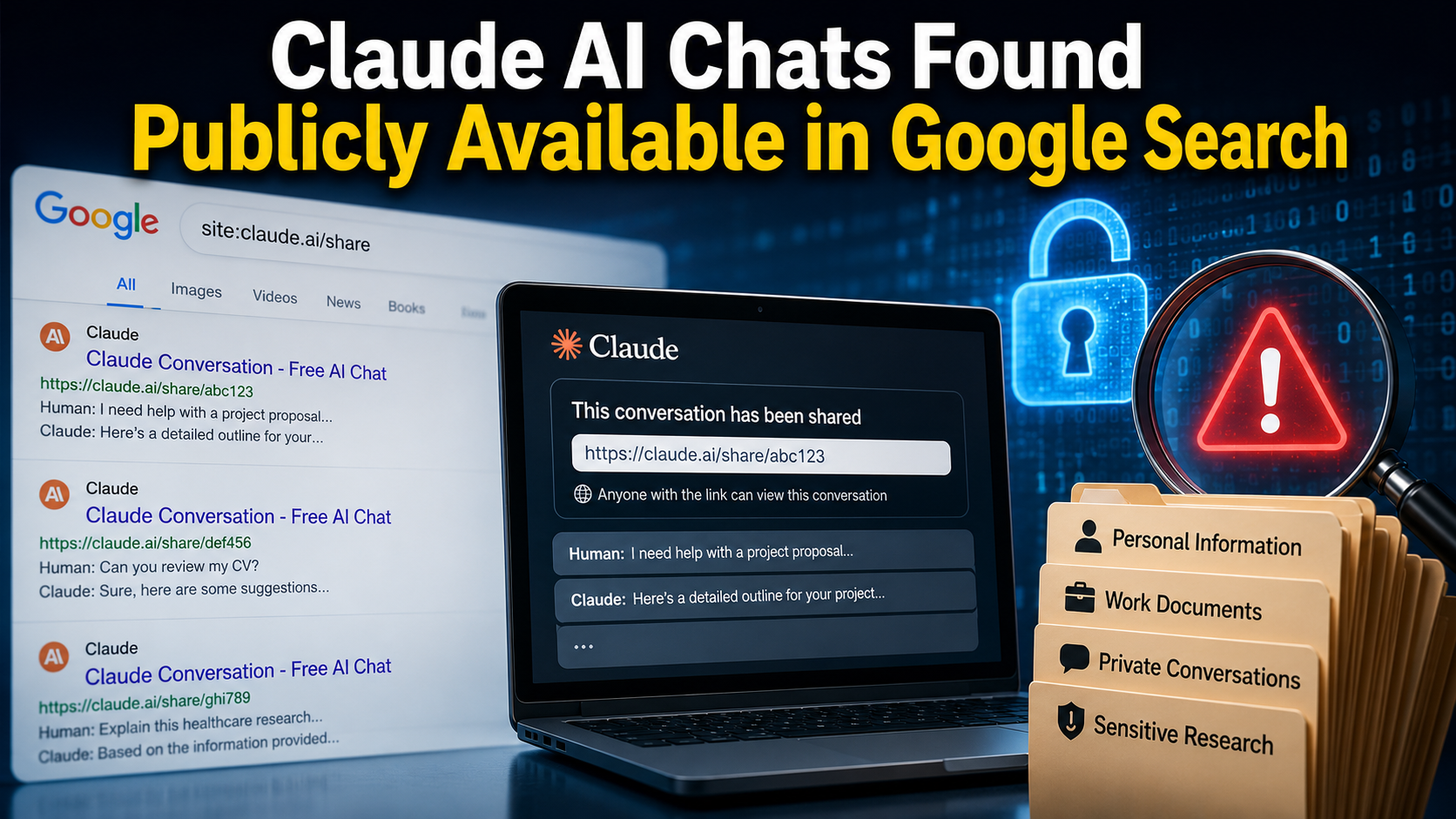
Hundreds of conversations with Anthropic’s Claude AI chatbot were found publicly accessible through Google and other search engines after users shared links to their chats, with some conversations containing personal information, workplace details and potentially sensitive research.
The discovery has raised fresh questions about AI chatbot privacy, particularly around what happens when users choose to share conversations publicly.
According to the BBC report, the conversations were not private chats that had been independently hacked. Instead, they were conversations that users had chosen to share through Claude's link-sharing feature. However, those shared conversations were subsequently indexed by search engines, making them discoverable through searches.
Claude AI Chats Appeared in Google Search
The issue emerged after users discovered that shared Claude conversations could be found using search engines.
The BBC reported that searches uncovered more than 200 conversations across at least 25 pages of search results. Some of the conversations had taken place only weeks earlier.
The chats covered a wide range of subjects, showing that people were using Claude for everything from everyday questions to professional and personal tasks.
Some conversations reportedly included:
-
Names and contact information
-
CV and employment details
-
Unpublished writing
-
Corporate project information
-
Healthcare-related research
-
Transcripts of private conversations
-
Personal questions and discussions
The discovery highlighted how easily information included in a publicly shared AI conversation can become accessible beyond the person originally given the link.
How Did Claude Conversations Become Public?
The key factor was Claude's share conversation feature.
When a user shares a Claude conversation, the resulting link allows other people with the link to view the conversation.
Anthropic told the BBC that users retain control over whether they share their conversations and said the links were not designed to be randomly guessable or discoverable.
However, once a conversation is intentionally made public, it can potentially be treated like other publicly accessible web content and archived by third-party services.
This distinction is important.
The incident does not appear to mean that Anthropic suddenly made every user's private Claude conversation searchable. Rather, the problem involved conversations that users had already chosen to share.
Anthropic Responds to Claude Privacy Concerns
An Anthropic spokeswoman told the BBC that Claude users control whether and when their conversations are shared.
The company said shared links are publicly accessible and can potentially be archived by third-party services once they have been made available online.
The share option itself reportedly tells users that anyone with the link can view the conversation.
However, according to the BBC's reporting, it does not explicitly warn users that a shared conversation could subsequently appear in Google or other search-engine results.
That distinction has become one of the central concerns surrounding the incident.
What Information Was Exposed in Claude Chats?
The publicly searchable conversations reportedly contained a mixture of harmless and potentially sensitive information.
Some users were using Claude to work on resumes, meaning conversations could contain names, contact information and employment histories.
Other conversations involved professional work.
The BBC found an example from April in which a user asked Claude to help draft an unpublished blog post about cloud security while providing details about a corporate project.
Other chats reportedly involved proprietary research, including research connected to healthcare and transcripts of private conversations.
This demonstrates why users should be cautious when sharing AI conversations containing information that was not intended for public distribution.
Claude Users Also Shared Personal Conversations
Not all of the publicly accessible conversations involved professional information.
The BBC found users discussing personal questions and unusual subjects with Claude.
In one conversation, a user asked Claude whether it wanted to help the user or Anthropic. In another, a user asked how to literally transform from a human into a nine-tailed fox.
These examples illustrate the broad range of information people may disclose when interacting with conversational AI.
Even apparently harmless conversations can potentially contain personal details that users may not want indexed publicly.
Google Says Website Owners Control Indexing
Google told the BBC that it does not control what individual websites make public on the internet.
The company said website owners have controls that determine whether their pages can be crawled and indexed, and that Google respects those directives.
That means the responsibility for preventing shared Claude conversations from being indexed largely depends on how Anthropic handles publicly shared links and search-engine crawling.
The BBC reported that the search availability of the Claude conversations was removed over the weekend.
This suggests Anthropic used available mechanisms to prevent the affected links from continuing to appear in search results.
Claude Chats Were Also Found Through Other Search Engines
The issue was not limited to Google.
According to the BBC report, Claude conversations had also appeared through Bing, Brave and DuckDuckGo.
The report said those search engines were approached for comment.
Because search engines can independently crawl and index publicly accessible pages, removing a page from one search engine does not necessarily mean that copies or cached versions disappear everywhere immediately.
Some Claude Chats Were Archived Online
Although the search availability of the conversations was removed, the BBC reported that many of the chats had already been saved and shared widely online.
That creates a more difficult privacy problem.
Once information has been copied, archived or reposted, simply removing the original search result may not completely eliminate access to the information.
This is a familiar problem across the internet: removing the original source does not necessarily remove copies that other users or third-party services have already created.
Similar Problems Have Affected Other AI Chatbots
Claude is not the first major AI chatbot to face concerns over publicly accessible conversations.
The BBC noted that ChatGPT experienced a similar issue last year, after chat logs were made publicly accessible through search.
OpenAI subsequently changed how easily those conversations could be discovered.
The social platform X also experienced an even larger incident involving hundreds of thousands of Grok chat logs becoming publicly available through online search.
The repeated incidents demonstrate that AI chatbot privacy is becoming a broader industry issue rather than a problem limited to a single company.
What Does This Mean for Claude Users?
The incident highlights an important rule for anyone using AI chatbots:
A conversation should not be treated as private once you deliberately share it through a public link.
Users should avoid putting confidential information into a conversation that they intend to share publicly.
This is particularly important for:
-
Business documents
-
Client information
-
Passwords and authentication details
-
Private conversations
-
Medical or healthcare information
-
Internal company research
-
Unpublished work
-
Personal identification details
Even if the original intention is simply to send a conversation to one colleague or friend, users should understand exactly who can access the shared link before posting it online.
Are Private Claude Chats Public?
The BBC report does not indicate that all private Claude conversations were publicly searchable.
The conversations identified in search results were chats that users had chosen to share through Claude's sharing mechanism.
Anthropic said shared links were not supposed to be guessable or discoverable unless users chose to share them.
The important privacy issue is therefore the difference between a private conversation and a publicly shared conversation.
Why Search Indexing Matters
Search indexing can dramatically expand the audience for information that was originally shared with a limited group.
A person might share a Claude conversation because they want a colleague to review it.
But if the resulting page becomes searchable, someone who was never given the link may potentially discover it through a relevant search query.
That is why the incident matters beyond the number of conversations identified.
It raises questions about how AI companies communicate the consequences of their sharing features and how clearly users understand the difference between “anyone with the link” and “not indexed by search engines.”
Claude AI Chats Privacy — Key Facts
| Detail | Reported information |
|---|---|
| AI chatbot | Claude |
| Company | Anthropic |
| Chats discovered | More than 200 |
| Search-result scale | At least 25 pages |
| How chats became accessible | Users shared conversation links |
| Search engines involved | Google, Bing, Brave, DuckDuckGo |
| Information found | Personal, professional and research-related content |
| Current search status | Search availability removed |
| Copies | Some chats reportedly archived/shared online |
| Similar incidents | ChatGPT and Grok |
Claude AI Chats — FAQs
Were private Claude chats leaked?
The reported conversations were shared chats, rather than evidence that all private Claude conversations were exposed. Users had chosen to create public share links, which could then be discovered through search engines.
How many Claude conversations were found?
The BBC reported that searches uncovered more than 200 Claude conversations across at least 25 pages of search results.
Could Claude chats appear on Google?
Yes. Shared Claude conversations were reportedly indexed by Google and could be discovered using search queries. The search availability was later removed.
What information was contained in the chats?
Some conversations contained names, contact information, employment histories, corporate project details, unpublished work, healthcare research and transcripts of private conversations.
Did Anthropic remove the chats?
The BBC reported that the search availability of the affected conversations was removed over the weekend. However, some conversations had already been archived or shared elsewhere online.
Did Google cause the problem?
Google said it does not control what websites make public and that website owners have controls governing crawling and indexing.
Is Claude safe to use?
Claude can still be used, but users should avoid sharing confidential or sensitive information through public conversation links. The incident demonstrates that publicly shared AI conversations can potentially reach a much wider audience than originally intended.
Bottom Line
The discovery of hundreds of publicly searchable Claude AI chats highlights a growing privacy challenge for AI chatbot users.
The conversations were reportedly made public through Claude's sharing feature, and more than 200 chats across at least 25 pages of search results were discovered. Some contained personal information, work-related material and potentially sensitive research.
Anthropic says users control when conversations are shared, while Google says website owners control whether their pages can be crawled and indexed. The search results have since been removed, but the BBC reports that some copies were already archived and circulated online.
For users, the lesson is straightforward: never include confidential information in an AI conversation that you plan to share publicly, and always understand exactly what a “share” link allows other people to access.
Published: July 29, 2026
Category: Technology / AI
Author: PakGenZ Technology Desk
Source: BBC News
Leave a Comment
Your comment will appear after review.