
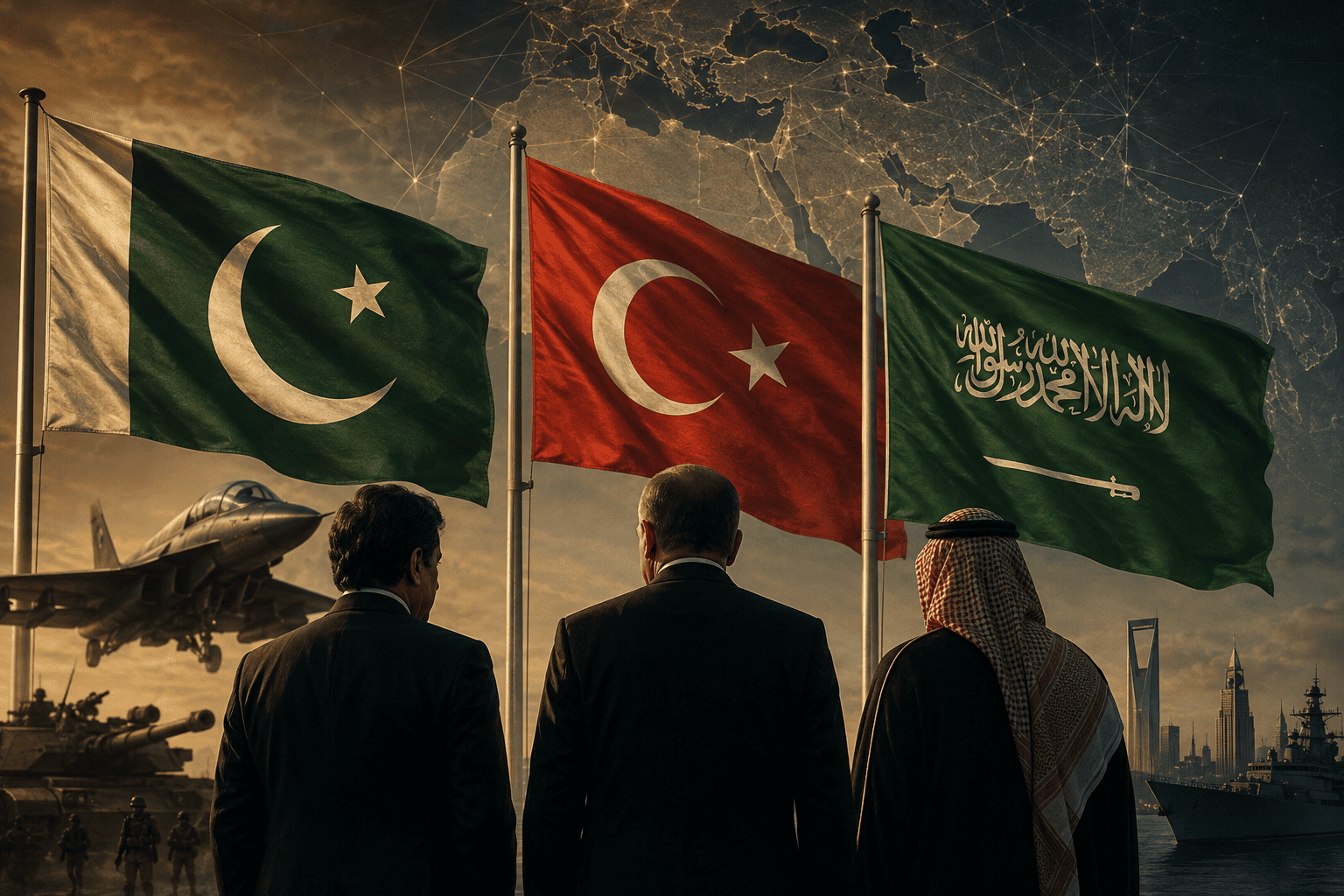
Pakistan, Turkiye and Saudi Arabia have taken a major step toward deeper regional security cooperation, and now the big question is: who could join them next?
The newly signed Mecca Joint Defence Agreement between Pakistan, Türkiye and Saudi Arabia has put a fresh spotlight on the changing security landscape of the Middle East and South Asia.
The agreement says that an armed attack against any one of the three countries would be regarded as an attack against all three a mutual-defence commitment that Turkish officials have compared with NATO’s Article 5 principle.
But the alliance may not stop at three countries.
Could Egypt Be the Next Member?
Egypt appears to be the strongest candidate to join the new defence framework.
Turkish Foreign Minister Hakan Fidan has indicated that Cairo could become part of the agreement in the future. Egypt already has close strategic relationships with Saudi Arabia and Türkiye and is a major military and geopolitical player in the Arab world.
If Egypt joins, the group would effectively bring together four major Muslim-majority states with significant military capabilities and strategic positions across the region.
The four countries are also associated with the broader R4 grouping — Türkiye, Saudi Arabia, Pakistan and Egypt — making Cairo's potential participation particularly significant.
🇶🇦 What About Qatar?
Qatar could also be discussed as a potential partner because of its strong defence and diplomatic relationships in the Gulf.
However, there is currently no confirmed announcement that Qatar will join the pact.
The same applies to other Gulf states. Their possible participation would depend on their own strategic interests, existing defence arrangements and relationships with major global powers.
🇦🇪 Could the UAE Join?
The United Arab Emirates is another country that could attract attention if the alliance expands.
The UAE has significant military capabilities and maintains close relationships with Saudi Arabia and other regional powers.
But again, there is no confirmed UAE membership at this stage.
For now, speculation about additional Gulf members should not be confused with an official expansion of the pact.
🇯🇴 What About Jordan?
Jordan is another strategically important Arab country with long-standing military and security relationships across the region.
Its geographic position also makes it relevant to any wider Middle Eastern security arrangement.
Still, there has been no confirmed announcement that Jordan is joining the Mecca defence agreement.
Why Is Egypt Different?
Egypt stands out because its possible membership has been directly mentioned by Turkish officials.
The country's military strength, control of the Suez Canal and strategic position between North Africa and the Middle East would give the alliance additional geopolitical weight.
An expanded Pakistan-Türkiye-Saudi Arabia-Egypt framework would stretch from South Asia to the Middle East and North Africa, creating a much broader security network.
What Does the Pact Actually Mean?
The agreement is not simply another military cooperation deal.
Its most important feature is the principle of collective defence.
Under the pact, an attack on one member is treated as an attack on all three. Turkish Foreign Minister Hakan Fidan described the arrangement as technically similar to NATO's Article 5, although the agreement is a separate regional framework and does not replace existing alliances.
The countries are also expected to establish regular meetings involving foreign and defence officials, while a permanent secretariat is planned in Saudi Arabia.
Is the Pact Against Iran?
Türkiye says no.
Turkish officials have specifically rejected the idea that the agreement is aimed at Iran or any particular country.
Fidan said the pact does not identify a specific enemy and is instead intended to strengthen collective security and deterrence.
That clarification is important because the agreement comes at a time of serious regional tensions.
Why Is Pakistan's Role Important?
Pakistan brings something different to the partnership.
It has one of the region's largest military forces and extensive defence experience, while also maintaining long-standing military ties with Saudi Arabia and Türkiye.
For Islamabad, the agreement could further strengthen its strategic relationship with Riyadh while deepening defence cooperation with Ankara.
For Saudi Arabia, Pakistan provides an experienced military partner.
For Türkiye, the pact creates another platform for regional security cooperation.
That makes the partnership strategically important for all three countries.
The Bigger Picture
The most interesting part of the new agreement may not be the three countries that signed it — but whether it eventually becomes a larger regional security bloc.
For now:
- Pakistan — founding member
- Saudi Arabia — founding member
- Türkiye — founding member
- Egypt — potential future member
- UAE — no confirmed membership
- Qatar — no confirmed membership
- Jordan — no confirmed membership
If Egypt eventually joins, the strategic importance of the alliance could increase significantly.
But for the moment, the key development is clear: Pakistan, Türkiye and Saudi Arabia have created a new mutual-defence framework, while the door appears to be open for other countries to join.